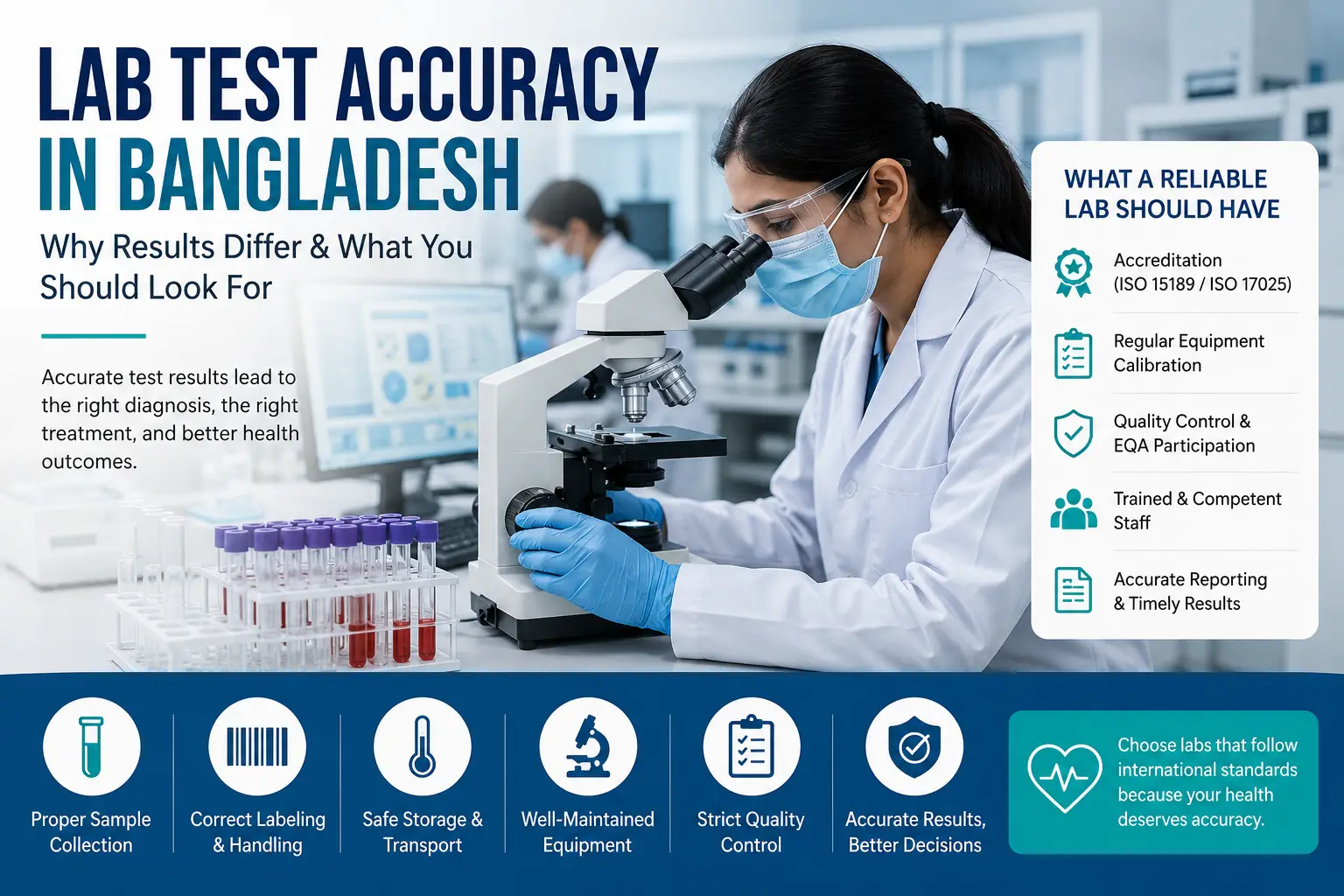
Why lab test accuracy in Bangladesh is harder than it looks
Lab test accuracy in Bangladesh varies more than most patients realise, and the gap between a reliable result and a misleading one can have real clinical consequences. Doctors occasionally see two patients with almost identical symptoms return with results from different labs pointing in opposite directions. This is not a freak occurrence. The variation follows predictable patterns: how a sample is handled, whether equipment is properly maintained, and how stretched the staff are on a given day.
Many patients have no way of knowing which labs are managing these risks well and which are not. They pick a centre based on proximity, price, or a relative's recommendation, hand over their sample, and trust the number that comes back. That trust is not always warranted. This guide explains what drives result variation, which quality signals actually matter, and what steps you can take before you hand over your sample.
Lab test accuracy in Bangladesh: why results differ between centres
Result variation across labs is not random. It follows patterns rooted in how samples are handled, how equipment is calibrated, and how much pressure technicians are under on a given morning. Data from studies conducted in Bangladeshi diagnostic centres show that nearly half of all documented inaccuracies originate before the sample even reaches the analyser. The machine is not always the problem.
The pre-analytical phase is where most errors happen
Pre-analytical refers to everything that happens to a sample between collection and analysis. In high-volume Bangladeshi centres, sample misplacement accounts for 38.5% of documented errors, and incorrect labelling accounts for another 17.9%. Beyond those two, haemolysis from improper storage, incorrect tube selection, and transport delays in Dhaka's heat can all compromise sample integrity before the analyser ever processes them. A result built on a degraded sample is not a reliable result, regardless of how sophisticated the equipment is.
Workload compounds all of this. Seventy point eight per cent of documented errors in Bangladeshi labs occur on peak workload days, when a centre processes hundreds of samples before midday. When staff are rushed, concentration drops, labelling shortcuts creep in, and the risk of cross-contamination rises. Inadequate training on current standard operating procedures makes this worse. Morning shifts carry the highest documented error burden; these are also the hours when many samples are collected in high-volume centres.
Equipment calibration and automation gaps
Older or poorly maintained analysers drift in their readings over time. Without regular calibration checks, a machine that was accurate six months ago may produce readings that are systematically high or low today. Many mid-tier diagnostic centres in Bangladesh still rely on semi-manual or partially automated workflows, which introduces operator-to-operator differences that fully automated systems eliminate. When a result depends partly on how a particular technician pipettes or reads a measurement, that result is inherently less reproducible across time and across labs.
What accreditation actually tells you about a lab
Not all labs displaying quality-sounding certificates are genuinely accredited. Accreditation is a formal, evidence-based process, not a certificate you purchase from a consultancy. Patients concerned about lab test accuracy in Bangladesh should understand two relevant standards: ISO 15189 for medical laboratories and ISO/IEC 17025 for testing and calibration laboratories. Knowing who grants these accreditations, and what the process involves, helps you ask better questions. To verify a lab's status, check BAB's public registry or request the lab's accreditation number directly.
The Bangladesh Accreditation Board (BAB) and ISO 15189
BAB is the sole government-authorised accreditation body for medical laboratories in Bangladesh. ISO 15189 is specifically designed for clinical labs: it covers personnel competence, equipment management, quality assurance, and result reporting. BAB conducts annual surveillance reassessments for accredited labs, meaning accreditation is not a one-time award. The honest reality is that formal ISO 15189 accreditation remains uncommon among private diagnostic centres in Bangladesh. icddr,b was the first laboratory in the country to earn it; Chevron Clinical Laboratory in Chittagong was the first in that city. According to available BAB registry data, ISO 15189 certification among private Dhaka centres remains limited, though a precise national percentage is not publicly published. For context on Bangladesh's progress in testing quality at the national level, see the World Health Organization's note on Bangladesh achieving international recognition in quality testing for medicines: WHO recognition of Bangladesh's advances in quality testing.
External quality assessment and proficiency testing participation
External quality assessment (EQA) works like this: an independent body sends a lab a mystery sample and checks whether the lab's results fall within acceptable ranges. It is one of the most reliable tests of a lab's real-world accuracy. Bangladesh does not yet have a national EQA programme. Major national reference laboratories participate in international schemes, including the EQASIA project. Among private Dhaka labs, Padma Diagnostic Centre and Praava Health both participate in the RIQAS international quality assessment scheme, which benchmarks results against more than 25,000 labs globally. For most routine private labs, participation in any external proficiency testing programme is currently voluntary and uncommon. That gap matters. For a technical reference on how external quality assessment programmes should be implemented, see the WHO implementation guide for external quality assessment programmes, and for practical listings of available EQA schemes see Labquality's overview of EQAs.
The tests most likely to give inconsistent readings
Not all tests carry the same variability risk. Some are relatively stable across labs; others show significant variation even between centres that consider themselves reputable. Understanding which tests demand extra scrutiny helps you decide when to accept a single result and when to cross-verify.
CBC results and the platelet count problem
Inter-laboratory platelet count variation in Bangladesh has been documented at up to 142 ×10⁹/L in a single study comparing labs across the northern zone. That is a clinically significant discrepancy: the same blood drawn at the same time could return a count that triggers urgent intervention at one lab and a watch-and-wait approach at another. International standards set the acceptable coefficient of variation for platelet counts at 3% for normal ranges, with adjustment upward at low counts. Bangladeshi inter-laboratory data frequently exceeds these thresholds. Haemoglobin and white cell counts show similar patterns of statistically significant variation that exceed acceptable international benchmarks. For a plain-language reference on expected platelet ranges, see this summary of the normal platelet count range.
PCR and molecular tests
PCR test variability is a known challenge even in well-resourced settings, and Bangladesh-specific comparative data remains limited. Cross-contamination during pipetting and inadequate access to certified reference materials are concerns noted in published assessments of diagnostic capacity in the local context. For any molecular test with significant clinical consequences, including infectious disease panels, genetic markers, or cancer-related assays, scrutinising the lab's quality controls is the appropriate response to an environment where external verification is limited.
How to assess lab test accuracy in Bangladesh before handing over your sample
You do not need a technical checklist. You need a set of questions and observations that any patient can make in five minutes at reception. The following two approaches give you a practical basis for choosing where to test.
What to observe and ask at the collection point
Look at the sample collection area. Is it visibly clean and organised? Are staff wearing gloves consistently? Does the lab display its accreditation certificate openly, rather than tucked away in a corner? Can a receptionist tell you which analyser brand they use and when it was last serviced? A credible lab will answer these questions without hesitation, though bear in mind that reception staff may need to fetch a technician for the more technical details; this is normal even in well-run centres. Vague or dismissive responses are themselves informative. You are also entitled to ask whether the lab participates in any external quality assessment scheme. If the receptionist does not know what that means, that too tells you something.
Using comparison guides to shortlist reliable centres
Independent research on diagnostic centre quality takes time most patients do not have, especially if they are unwell or travelling from outside Dhaka. Levree Health publishes comparison guides on diagnostic centres in Bangladesh, covering reliability indicators such as accreditation status and EQA participation, so you can shortlist before you arrive rather than guessing on the day. Whether you are based in Dhaka or travelling from Chattogram or Sylhet for specialist tests, a vetted shortlist is a more reliable starting point than relying on proximity or word-of-mouth alone. For targeted comparisons and rankings, see our pieces like Ibn Sina vs Popular Lab: Which is better in Bangladesh?, our broader ranking of centres in the capital at Best diagnostic centres in Dhaka: top labs ranked 2026, or browse the diagnostic lab comparison Bangladesh Archives for related articles and updates.
When two results do not match and what to do about it
Discordant results from two labs do occur and are reported in the literature, they are a legitimate clinical event that demands investigation, not dismissal. Patients often feel uncomfortable raising the issue, as though questioning a result implies distrust of their doctor. They should not feel that way.
Red flags that warrant a retest
Request a retest when a result contradicts clinical symptoms your doctor has already noted, when a platelet or white cell count differs by more than 20% from a result taken within the same week without clinical explanation, or when a positive result on a sensitive molecular test comes from a lab you have reason to question. A retest at a BAB-accredited centre with documented EQA participation is a reasonable and responsible step. It is not paranoia. It is how you manage genuine diagnostic variability.
How to approach your doctor with conflicting results
Bring both reports to the consultation. Note the date and time of each sample collection. Ask your doctor directly which result they intend to act on and why. A good clinician will factor the lab's known reliability into their interpretation. The source of a result is clinically relevant information, not an administrative detail. If your doctor dismisses the discrepancy without explanation, that is worth noting. Diagnostic reliability in Bangladesh varies enough that clinical judgement should always weigh where a result came from alongside the number itself.
The bottom line on lab test accuracy in Bangladesh
Lab test accuracy in Bangladesh is a real and documented issue, not patient paranoia. Pre-analytical errors, equipment gaps, and limited quality oversight create genuine result variability, particularly in high-pressure labs running large volumes during morning peaks. The strongest quality signals available to patients are BAB accreditation under ISO 15189, participation in EQA programmes such as RIQAS, and documented use of automated equipment with regular calibration records.
Patients who know what to look for, ask the right questions at reception, and use reliable comparison resources will get meaningfully better diagnostic outcomes than those who do not. Choose where you test as carefully as you choose which test to take. The result you act on is only as good as the process that produced it.